
Medium
Inspiration
Inspiration
Local hardwoods: walnut, cherry, hickory, and maple sculpted without power tools, sandpaper, or fasteners. This is the meaning of hand made. Silva Decorus is Latin for Wood Finely Formed, in reference to the entire process from seedling to tree to lumber to finished piece.
Inspiration
Inspiration
Inspiration
Raised in Iowa and now residing in Wisconsin, I spent my formative years studying the Prairie School and wandering the East Building of the National Gallery. From architecture to 20th century painters and sculptors to the natural world all assembled in a uniquely new and modern aesthetic.
Evolution
I have always felt a deep need to create.
My first declaration of how I wanted to spend my life was at a very young age, Artist!, and my work is a reflection of everything I see told through geometry and proportion.
Having spent my formative years outside exploring the prairies, lakes and forests of the Midwest, it was natural I’d choose wood, or it would choose me.
Around age ten while at the family contracting business I discovered blue prints, and they resonated. I bought books of house plans and studied not just the drawings but the relationships of the forms. I would reinterpret what I saw into my own designs, always seeking to improve them. Of all things a window ad radically changed my ideas of what could be-a stark white house with floor to ceiling windows, all lit up. It was abstract geometry that created a living space far from the 60’s ranch I was growing up in. Noticing my persistently growing interest in architecture my da asked if I’d ever heard of Frank Lloyd Wright. I hadn’t, and this was the eighties so I got on my bike and went to the library to check out some books. Now these were drawings. I couldn’t get enough of the floor plans and renderings. I spent hours and hours pouring over them.


Visiting Frank Lloyd Wright’s Home and Studio c.1990
I.M. Pei’s East Building of the National Gallery of Art, Washington D.C.


Initially focused on building traditional pieces with raised panels and dovetails I spent ten years collecting hand tools and honing my skills. Resettling in Wisconsin surrounded by wonderful dense hardwood forests I had the good fortune of meeting an arborist who showed me huge slabs of Ash, Hickory, Walnut, Cherry, and Maple I didn’t think could even exist. Having discovered natural edged lumber I transitioned into building big and bold Nakashima-style pieces. I showed in a few local galleries and then a commission came around that completely transformed my approach once again.

I was asked to create a hanging sculpture mounted to a two story stone fireplace in of all places, a Prairie Style house.

By looking at Wright’s stained glass windows, carpets and magazine covers and piecing together scraps to create the general form this was a higher-level creative process. This piece felt different. I needed to evolve and grow from this, but how?

I shifted the presentation from horizontal to vertical as a reflection of those trips to Chicago while growing up and appreciating the skyline. I remembered the mile-high skyscraper, The Illinois, that Wright designed as a challenge. Many wall hanging prototypes followed but I needed a bigger challenge.

Around this time The Milwaukee Art Museum displayed an exhibit of the works of Charles Rohlfs and the form of his desk chair stuck with me. I could turn my wall hangings into chairs with a similar tall back.
A year later I had my first set of chairs. Building off a different wall hanging I had a second set of chairs. Refining the first set, I had my third set of chairs. It wasn’t until the fourth set that felt I had pushed myself far enough I was ready for display. Getting to see my pieces in a Wright-designed building was a thrill beyond measure.
In revisiting Wright’s work for the hotel display, the Kith/New Balance/Frank Lloyd Wright Foundation shoes were released, causing me to find further inspiration in the colors and geometry of their inspiration, Wright’s Broadacre City.
Thus the tables.



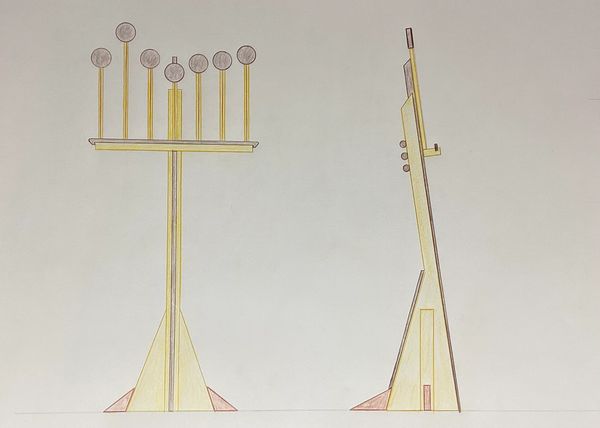
Where to now? Mason City, Iowa is also home to Meredith Wilson who wrote The Music Man. Always pushing my limits, a Music Stand.
What began as a simple need to create, my work provides order and calm and helps make sense of, and connect to, it all.